Showing posts with label Extension. Show all posts

Thursday, January 31, 2008

Trunk - Abdominal and Back Stretching

In considering the trunk or "core" of the body, which is basically everything from the pelvis up to the rib cage, in regards to stretching there is really no way to isolate one specific muscle or muscle group. We'll therefore consider stretching exercises which stretch all the multitude of muscles involved in both the abdominal and lower back region.
This area is strategically significant in regards to stretching and fitness for several reasons. The area between the pelvis and rib cage not only holds in the majority of our bodily organs (intestines, kidneys, liver, spleen, and so forth) it is also very vulnerable to injury due to the fact that this region provides all the stability for the upper trunk and arm movements and activities, with only the lower spine and lower trunk musculature for support.

It is referred to as "the core" of the body because all upper and lower body movements are stabilized and coordinated through the contraction and stability of the abdominal and lower back regions. Stretching this area is therefore a critical part of any flexibility and fitness program to prevent injury and help maintain proper postural alignment.

The stretches can be catagorized into four basic planes of movement: flexion, extension, lateral flexion and rotation - (with varied combinations of the four)


Back Extension stretching


Lateral Flexion Stretching


Trunk rotation stretch


Rotational Flexion Stretch (Windmill)


Saturday, January 26, 2008

Gluteal Stretching

In our continued focus on stretching, today we'll wrap up our coverage of the leg with the muscle group which is arguably the biggest and strongest in the body, the Gluteal muscles. Two muscles, the Gluteus Maximus and Gluteus Minimus, make up what is also referred to as the buttocks (and other names which I will not mention here).

These muscles are responsible primarily for extension of the hip joint (and to help keep our pants up above our waistline unless you are one of those unfortunate souls who thinks its cool to walk with the waist of your pants hanging precariously on the minor curvature of your hamstring muscles!)

Stretching these muscles requires a combination of hip flexion and also a little bit of internal rotation of the hip to get the most optimal results.
Basic Gluteal Stretch


Advanced Gluteal Stretch


Combination Flexion/Rotation Stretch


Thursday, January 17, 2008

Stretching Fitness - Hamstring Health

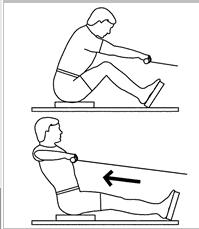
With our continued focus on stretching exercises necessary for good flexibility, fitness and injury prevention, and having already addressed the calf muscle, we'll now work our way up the back of the leg to the Hamstring Muscles.
What we call the Hamstring (or more affectionately, the Hammies) is actually a set of three muscles called: Biceps Femoris, Semimembranosus, and Semitendinosus. These three muscles are mainly responsible for bending or flexing the Knee joint, but as they also cross the back of the hip joint the also help with hip extension.

If you've ever done a lot of activity where you are bending forward with your knees straightened, like working on the engine of your car or pulling weeds out of your yard, you may have noticed these muscles the next day when they are protesting the sudden work you've put them through after not noticing them for so long!

The Hamstrings are relatively weak muscles in comparison to the more powerful Quadriceps muscles, located on the front of our thighs, and therefore are more prone to being overstrained or "pulled" as a result. Also because we spend so much time sitting these days, with our knees flexed in a bent position, the hamstring muscles tend to become a little shortened and tight. Thus the need for regular stretching of these muscles.

Again, no matter what level of flexibility or fitness you are, the main thing about stretching is to go slowly and hold the stretch at a comfortable level for at least 25-30 seconds.

Low Level Stretch
Intermediate level Stretch

Advanced Level Hamstring StretchThese stretches can be done for several repetitions as well as any other stretch. Remember, treat your Hammies right, and they will treat you right!
Happy Fitness!